How Much Does a Taj Mahal Quartzite Island Cost?
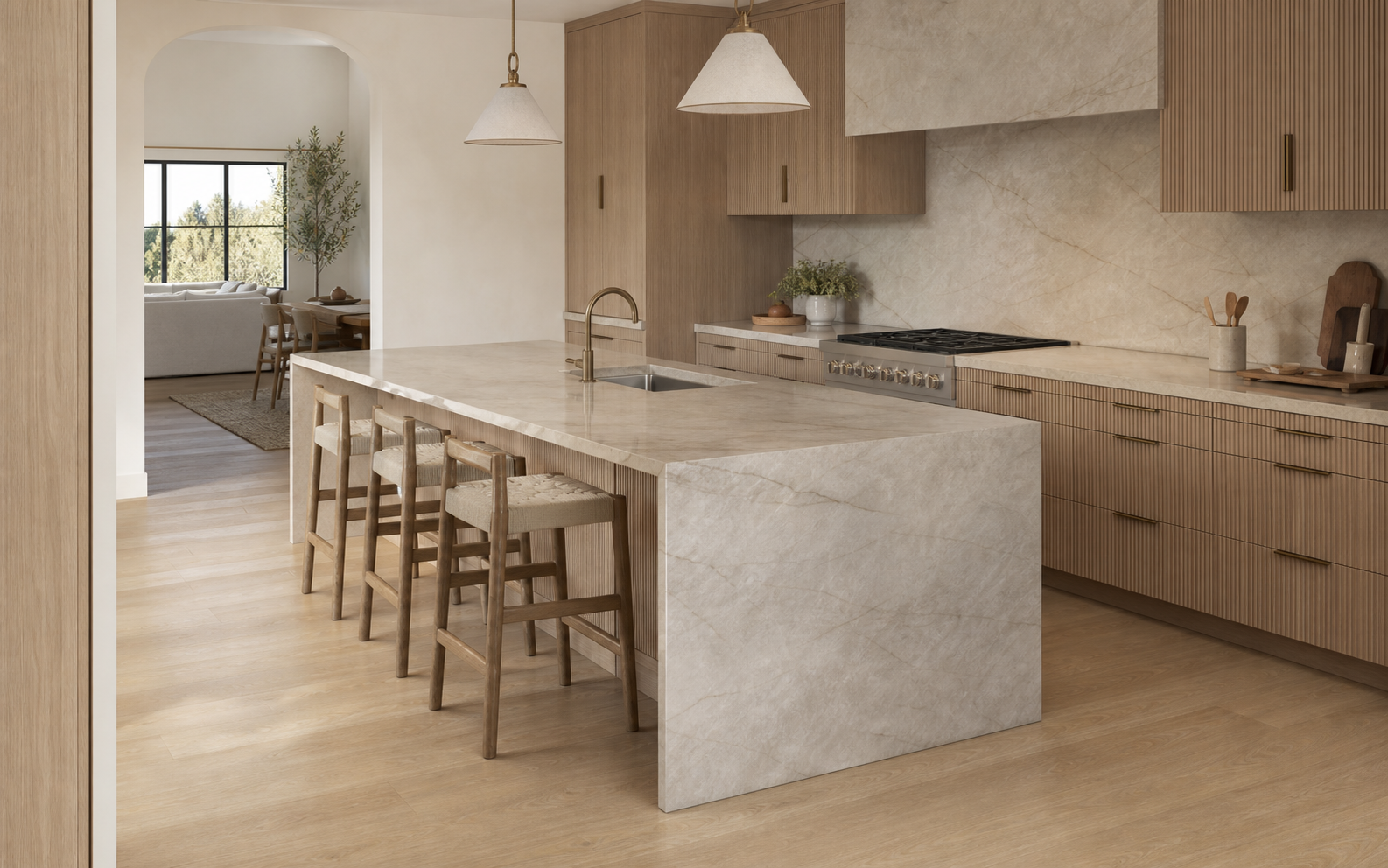
A real kitchen case: 12 square metres of finished Taj Mahal quartzite, three full slabs, US$5,202 in material, and US$4,200 in fabrication.
Public price snapshot
Taj Mahal quartzite prices in US dollars
| Market | Public price | What it covers |
|---|---|---|
| Finished stone area | 12 m2 net | The approximate finished countertop, island, waterfall, and backsplash area in this kitchen example. |
| Selected slabs | 3 x 2 m x 3 m | 18 m2 of gross material. The extra area allows for layout, cutting, waterfall ends, and natural stone variation. |
| Taj Mahal slabs | US$5,202 | US$1,734 per slab for the selected older-quarry material in this example. |
| Fabrication | US$4,200 | Cutting, polishing, edge work, planning, and producing the finished stone pieces for this design. |
| Stone + fabrication | US$9,402 | A practical US$10,000 project allowance for this specific stone scope. Each kitchen should still be quoted from its own drawing. |
A Taj Mahal island is not priced by one small sample
People often ask for the price of a Taj Mahal kitchen island as if it were one item on a shelf. Natural stone does not work that way. The final number comes from the selected slabs, the amount of usable stone after layout, and the fabrication required to turn those slabs into a clean kitchen.
This project is a useful real-world example. The kitchen uses about 12 square metres of finished Taj Mahal quartzite across the island, waterfall ends, working surfaces, and backsplash. To make it properly, we selected three full slabs measuring 2 by 3 metres each.
Three slabs give 18 square metres of gross material. That difference between 18 gross square metres and 12 finished square metres is not waste in the casual sense. It is what makes room for the island layout, cutouts, waterfall sides, edges, and the natural movement of the stone.
The material cost: US$5,202 for three selected slabs
For this American client, the three Taj Mahal slabs cost US$5,202 in total, or US$1,734 per slab. This was not the cheapest Taj Mahal available. We selected an older-quarry lot with a warm creamy background and soft, controlled movement.
That detail matters. Taj Mahal is sold under one familiar name, but not every lot has the same colour or character. Some newer material can show a noticeably greener cast or a busier look. It may still be Taj Mahal quartzite, but it creates a very different kitchen once the island is the centre of the room.
Before a slab is approved, we look at full photos and video, not just a small sample. For an island this large, the full slab is the design.
The fabrication cost: US$4,200
The fabrication for this design was US$4,200. That work turns three raw slabs into a coordinated kitchen: planning the layout, cutting the pieces, polishing edges, preparing cutouts, making the waterfall ends, and checking the final fit before packing.
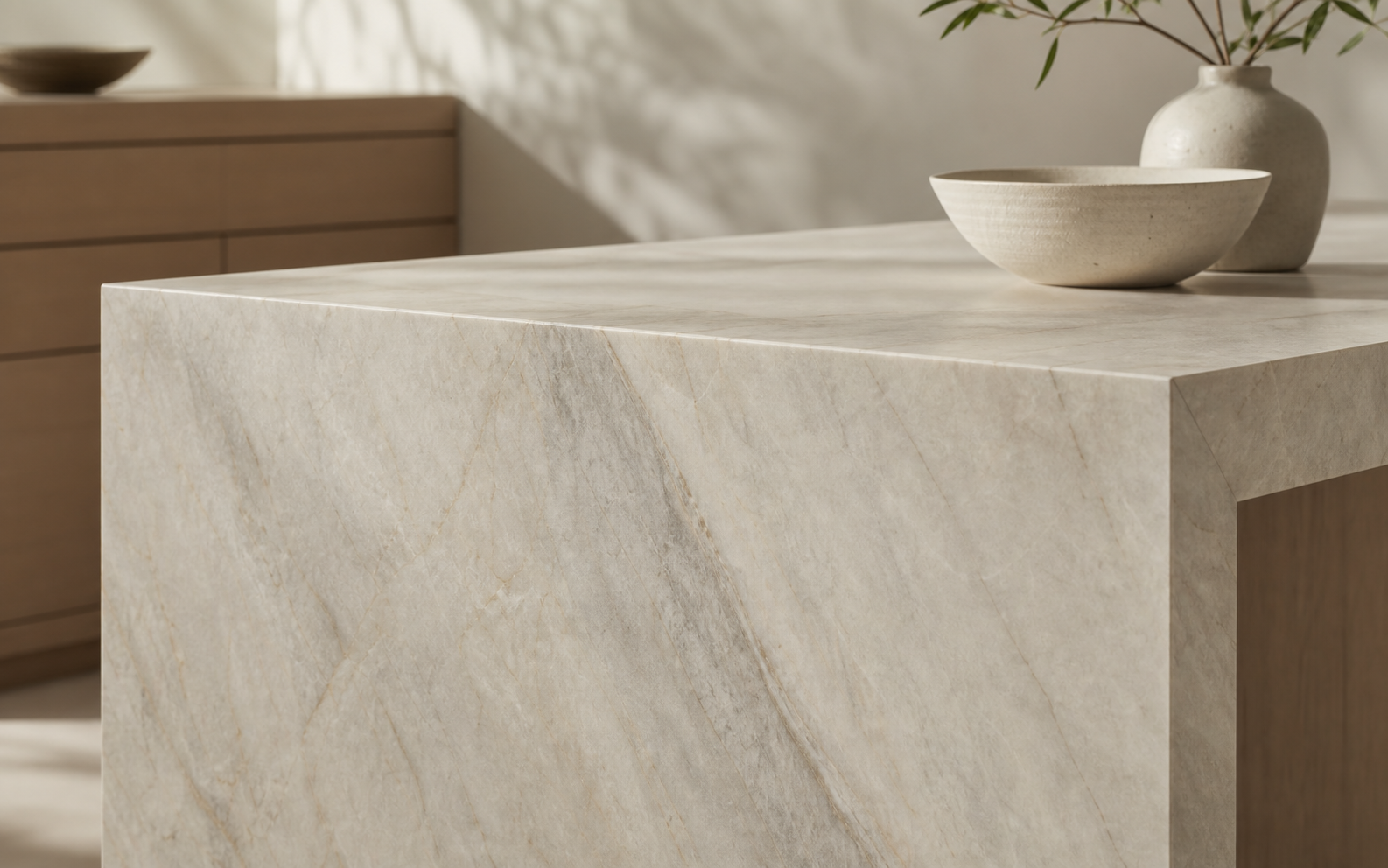
Fabrication is where a stone kitchen either looks calm and intentional or starts to look like separate pieces. The waterfall end needs a convincing mitred edge. The backsplash needs to sit cleanly against the cabinetry. Veins need to be placed thoughtfully rather than left to chance.
This is also why comparing only a local slab price can be misleading. The slab is important, but the finished work is what you live with every day.
The stone and fabrication subtotal is US$9,402
US$5,202 for material plus US$4,200 for fabrication gives a subtotal of US$9,402. For a kitchen with this amount of Taj Mahal, we would describe that as roughly a US$10,000 stone-and-fabrication allowance before preparing a project-specific quotation.
In many US retail yards, Taj Mahal slabs can begin around US$2,000 per slab, depending on grade, thickness, and local market. Three slabs can therefore reach about US$6,000 before custom fabrication begins. The point is not that every local quote is wrong. It is that the total project should be compared as a complete piece of work, with the actual slab quality visible.
A different layout, a thicker profile, bookmatching, extra backsplashes, or more cutouts will change the number. This example is useful because it gives a real scale: 12 square metres finished, three slabs selected, and a clear fabrication budget.
The right Taj Mahal is worth choosing carefully
A low number means very little if the stone does not have the colour you wanted. For this kitchen, the calm ivory background and gentle warm veining were the reason Taj Mahal made sense. The stone supports the cabinetry instead of fighting it.
That is why we start with the intended kitchen, not only a material name. Send John a reference image, rough dimensions, and the country where the project will be used. He can check current slabs and explain how many are realistically needed before you fall in love with a design that requires more material than expected.
Questions people usually ask
How many Taj Mahal slabs do I need for a large kitchen island?
It depends on the island size, waterfall ends, backsplash, slab dimensions, vein direction, and cutouts. In this example, about 12 square metres of finished stone required three 2 by 3 metre slabs, or 18 square metres of gross material.
How much did the Taj Mahal quartzite cost in this kitchen example?
The three selected slabs cost US$5,202 and fabrication cost US$4,200, for a US$9,402 stone-and-fabrication subtotal. It is a project example, not a fixed price for every kitchen.
Why is there more slab area than finished countertop area?
Natural stone projects need extra material for layout, waterfall ends, edges, cutouts, seam placement, and selecting the best parts of each slab. Gross slab area and finished surface area are rarely the same.
Does all Taj Mahal quartzite look the same?
No. Taj Mahal varies by quarry lot and grade. Some lots are warmer and creamier, while others can show greener tones or stronger movement. Always approve full slab photos or video before fabrication.