Taj Mahal Quartzite Price: China vs US, Australia, and the UK
The same warm Brazilian quartzite can be sold at very different prices around the world. Here is a clear look at public Taj Mahal slab prices, and why lower Chinese fabrication costs can matter just as much as the slab itself.
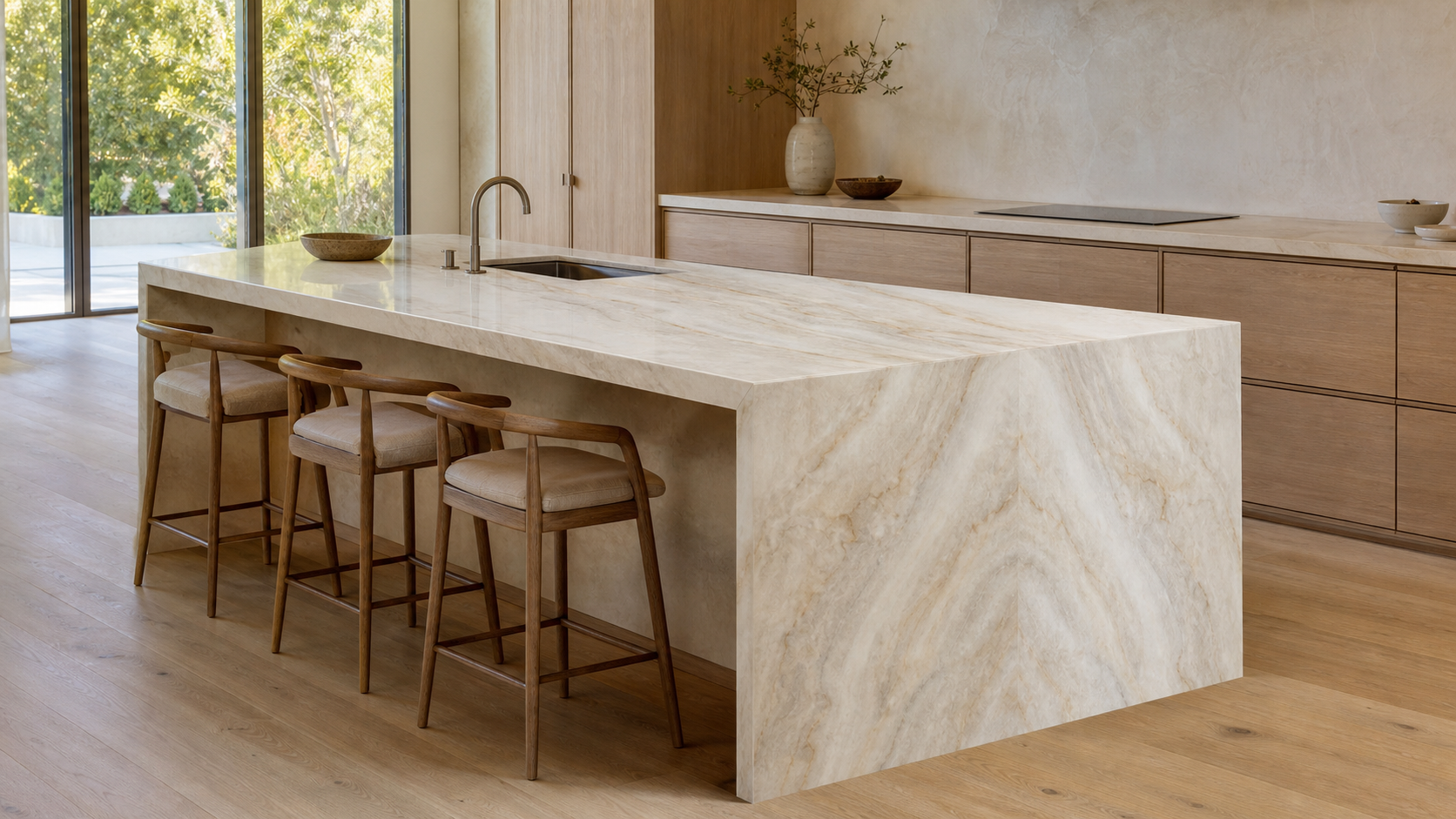
Public price snapshot
Taj Mahal quartzite prices in US dollars
| Market | Public price | What it covers |
|---|---|---|
| China source market | US$134-194 / m2 | Current working range for Taj Mahal slabs at RMB 900-1,300 / m2, using US$1 = RMB 6.7. |
| Australia, Sydney | US$349-536 / m2 | Public 20mm slab listings before GST. Including GST, about US$384-589 / m2. |
| United Kingdom | US$682-817 / m2 | Published Taj Mahal worktop supplier range of GBP 501-600 / m2, converted at the July 2026 reference rate used here. |
| United States | US$1,076-2,368 / m2 | Published retail material guide of US$100-220 / sq ft. This is slab material only, not installation. |
Taj Mahal is a stone people now ask for by name
Taj Mahal is a Brazilian quartzite with a warm ivory background and soft beige, grey, and gold movement. It gives many kitchens the calm marble look people want, while offering the harder, more practical character of quartzite.
It is also a useful stone for talking honestly about price. The name may be the same in every country, but the number a client sees can be dramatically different. A slab in a local showroom has already travelled through several businesses. A slab chosen closer to the stone market has a much shorter path before fabrication begins.
The public price snapshot above is not a promise that every slab is identical. Grade, thickness, finish, slab size, vein quality, and local tax all matter. It is a practical way to see how the market changes once the same category of stone reaches different countries.
First compare the slab, not a whole installed kitchen
A kitchen quote can include far more than stone: measuring, cutting, sink and cooktop cutouts, edges, reinforcement, transport, installation, and sometimes backsplashes or waterfall ends. That is why an installed kitchen price should not be compared directly with a slab price.
For this article, the clearest comparison is the slab itself. The current China source range we use is around US$134 to US$194 per square metre. Public 20mm Taj Mahal listings in Sydney sit around US$349 to US$536 per square metre before GST. Public UK worktop pricing is higher again, while a US retail material guide places Taj Mahal far higher at US$1,076 to US$2,368 per square metre.
Those public numbers also show why clients should ask what a price includes. They are a market snapshot, not a fixed worldwide price list. A rare bookmatched lot, a 30mm slab, or a particularly clean bundle can be much more expensive than a standard lot in any country.
The slab is only the first part of a custom project
A beautiful slab does not become a kitchen island or table by itself. Someone still has to plan the layout, make the cuts, polish the edges, prepare cutouts, reinforce weak areas, dry-fit the pieces, and protect them for transport.
This is where China can be especially compelling. Fabrication labor is generally lower than in the United States, Australia, or the UK, while Shuitou factories handle stone cutting, polishing, mitered edges, countertops, vanities, and furniture work every day. That combination can make custom details more achievable without turning a project into a luxury-only budget.
For a Taj Mahal island, the difference may be a thicker-looking mitered edge, a waterfall side with continuous vein flow, or a matching backsplash. For a table, it can be a custom shape, eased edge, hidden support plan, and safe packing. The goal is not just to buy a lower-priced slab. It is to make the finished piece well.
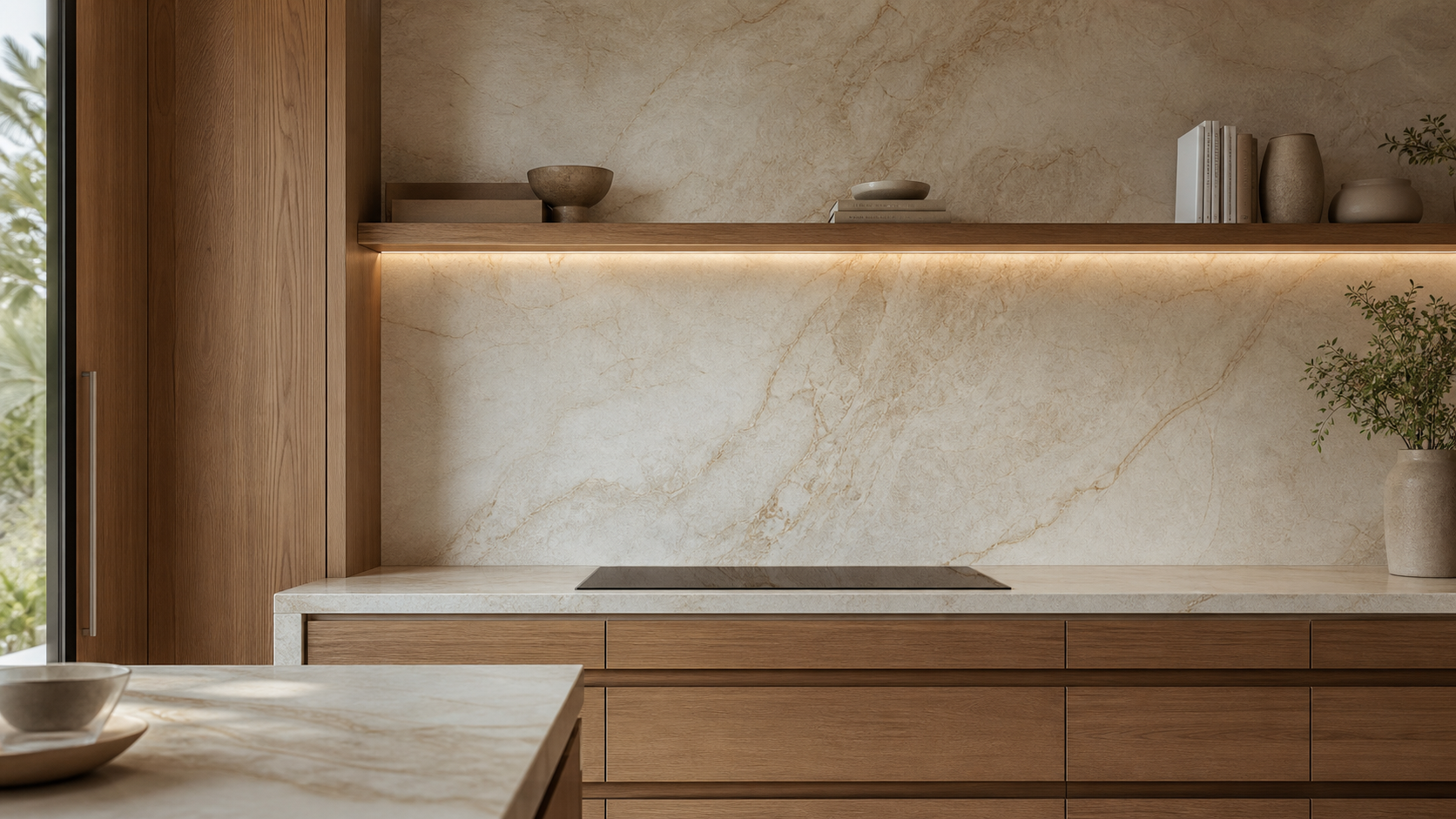
Why the finished price can still be attractive
Buying close to the source can lower the starting material cost. Lower fabrication costs can then make a larger difference when the design has more work in it: a kitchen with several cutouts, two vanity tops, a mitered island, a bookmatched wall, or a custom stone furniture piece.
That does not mean every project should be sourced from China. A single tiny repair, a rush job, or a project that needs local templating tomorrow may be better handled locally. Direct sourcing makes the most sense when the stone selection matters, the work is custom, or the project is large enough for the overall saving to be meaningful.
The useful question is not, "What is the cheapest Taj Mahal?" It is, "Can I get the right slab and the right finished work for a better total value?" That is the comparison John helps clients make before they commit.
How to get a useful Taj Mahal price comparison
Send John a reference photo, rough dimensions, and where the stone will be used. A kitchen counter, waterfall island, dining table, vanity, and wall each use the slab differently, so the best option depends on the finished design rather than a square-metre number alone.
John can then check the current slabs, suggest an appropriate grade and finish, and show what the design looks like as a complete stone project. That gives you a much more useful answer than choosing from one showroom sample and hoping the final quote stays close to it.
Public price references
Published US material guide lists Taj Mahal at US$100-220 per sq ft, excluding installation.
Updated April 2026 with installed Taj Mahal ranges by grade; useful context, but not used as a slab-to-slab comparison.
20mm Taj Mahal listed at AU$495 per m2 excluding GST when checked in July 2026.
20mm Taj Mahal listed at AU$759 per m2 excluding GST when checked in July 2026.
Supplier guide lists Taj Mahal worktops at GBP 501-600 per m2 when checked in July 2026.
Questions people usually ask
How much does Taj Mahal quartzite cost in China?
For the China source market range used in this article, Taj Mahal slabs are approximately US$134 to US$194 per square metre, based on RMB 900 to 1,300 per square metre at US$1 = RMB 6.7. Actual price changes with grade, slab size, thickness, finish, and vein quality.
Why is Taj Mahal quartzite more expensive in the US, Australia, or the UK?
Local retail pricing can include importing, warehousing, showroom costs, local labor, fabrication, installation, and margins at several stages. The exact mix changes by market, which is why a public price should always be checked for what it includes.
Does a lower slab price mean the finished countertop will be cheaper?
Not by itself. The final cost also depends on fabrication, edge details, cutouts, reinforcement, packing, transport, and installation. Lower material and fabrication costs can make a meaningful difference, especially for custom projects with more stone work.
Is Taj Mahal quartzite the same as marble?
No. Taj Mahal is generally sold as a Brazilian quartzite. It has a soft marble-like appearance, but quartzite is typically harder and more resistant to etching than marble. Natural stone still varies, so every selected slab should be checked for its own character and suitability.