What Is Shuitou, and Why Does So Much Stone Pass Through It?
A field note from the town where blocks, slabs, factories, and exporters sit close enough for one person to compare them in a single day.
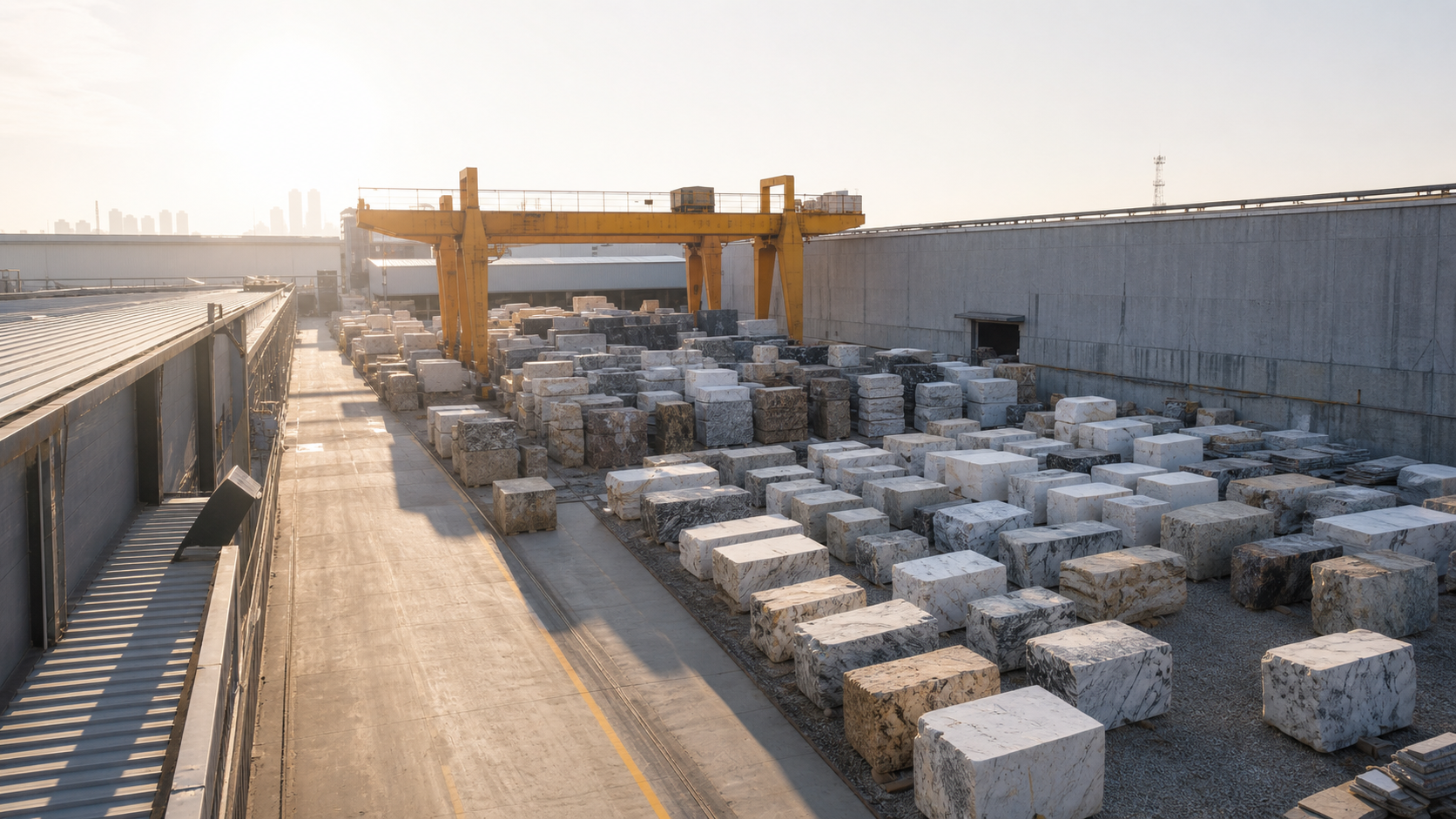
Shuitou is not one market
When people hear "stone market", they often imagine one building with a few showrooms. Shuitou is different. It is a whole stone town in Fujian, China, with block yards, slab warehouses, cutting factories, polishing lines, packing teams, and exporters sitting close to each other.
That closeness matters. A buyer can look at raw blocks in the morning, compare slabs after lunch, then visit a factory that can cut the same material into countertops, vanity tops, stair treads, tables, sinks, or wall pieces.
This is why so many natural stones pass through Shuitou before they appear in showrooms somewhere else. The stone may come from Italy, Turkey, Brazil, Iran, Greece, Vietnam, or China, but a lot of it is cut, selected, priced, and prepared for export here.
Why buyers care about being close to the source
Stone changes every time another person handles it. A quarry block becomes slabs. Slabs get sorted by color, vein, cracks, size, finish, and demand. The best pieces may be held, sold early, or separated from the rest before they ever reach a local showroom overseas.
Being close to the source does not magically make every stone cheap or perfect. It simply gives you more information earlier. You can compare more options, ask more specific questions, and understand whether the stone you like is common, rare, fragile, hard to match, or expensive to fabricate.
For custom countertops and furniture, this early information can prevent mistakes. A photo may look beautiful, but the slab might be too thin for a table edge, too fractured for a long island, or too inconsistent for matching two vanity tops. These are things someone on the ground can check before money is spent in the wrong place.
What John usually checks first
Most questions start with a photo. Someone sends a kitchen idea, a slab screenshot, an Instagram post, a hotel bathroom, or a drawing with rough measurements. The first job is not to sell a stone. The first job is to understand what the person is really looking at.
John usually checks the stone type, the likely name, whether similar slabs are available, how the material behaves, what size pieces may be needed, and whether the design should be made from slabs, tiles, cut-to-size pieces, or a more complicated fabricated part.
For example, a marble dining table and a marble countertop are not the same problem. A table may need a certain edge thickness, hidden support, careful packing, and a stone that still looks good as a furniture object. A countertop may care more about slab size, seam placement, surface finish, and kitchen use.
Shuitou is useful because the next step is nearby
One of the quiet advantages of Shuitou is that the next step is usually close. If a slab looks promising, someone can ask about cutting. If a design needs special edges, someone can check which factory is better for that work. If a piece is heavy or fragile, the packing question can be discussed before production begins.
That does not mean every project should be made in the same factory. Some factories are better at simple cut-to-size countertops. Some are better at furniture. Some are better at curved work, sinks, mosaics, stairs, or export packing. The useful thing is having options close enough to compare.
For overseas buyers, this is the part that is hard to see from a website. A low price may not include the right finish, crate, reinforcement, or inspection. A beautiful slab may not be the best stone for the use. A factory can be good at one thing and careless at another. Local checking makes those details less invisible.
What this means if you are buying from another country
If you are outside China, you do not need to become a stone expert overnight. But you do need someone to translate the messy middle: names, photos, slab quality, fabrication limits, packing, lead time, and shipping questions.
A good first message is simple. Send the look you like, the place where the stone will be used, rough dimensions, your country, and any deadline. With that, John can usually tell whether the idea is easy, difficult, expensive, risky, or worth exploring.
The best stone decisions are rarely made from one perfect picture. They come from comparing what is beautiful, what is available, what can be made well, and what can arrive safely. That is the real reason Shuitou matters.
Questions people usually ask
Is Shuitou only for Chinese stone?
No. Shuitou handles both Chinese stone and imported stone from many countries. Blocks and slabs from different origins are cut, traded, fabricated, and prepared for export there.
Can individual buyers source stone from Shuitou?
Yes, but it helps to have someone local check slabs, factories, packing, and shipping details. Stone buying has many practical details that are hard to judge from photos alone.
Is buying stone from China always cheaper?
Not always. The final cost depends on the material, fabrication, packing, shipping, duties, and project size. The advantage is often better selection and more direct comparison before the stone moves through more middlemen.