Why Buying Stone from China Can Cost Less Than Buying Locally
The saving is not magic. It usually comes from fewer middlemen, a bigger wholesale market, lower fabrication costs, and being closer to where blocks, slabs, and factories already meet.
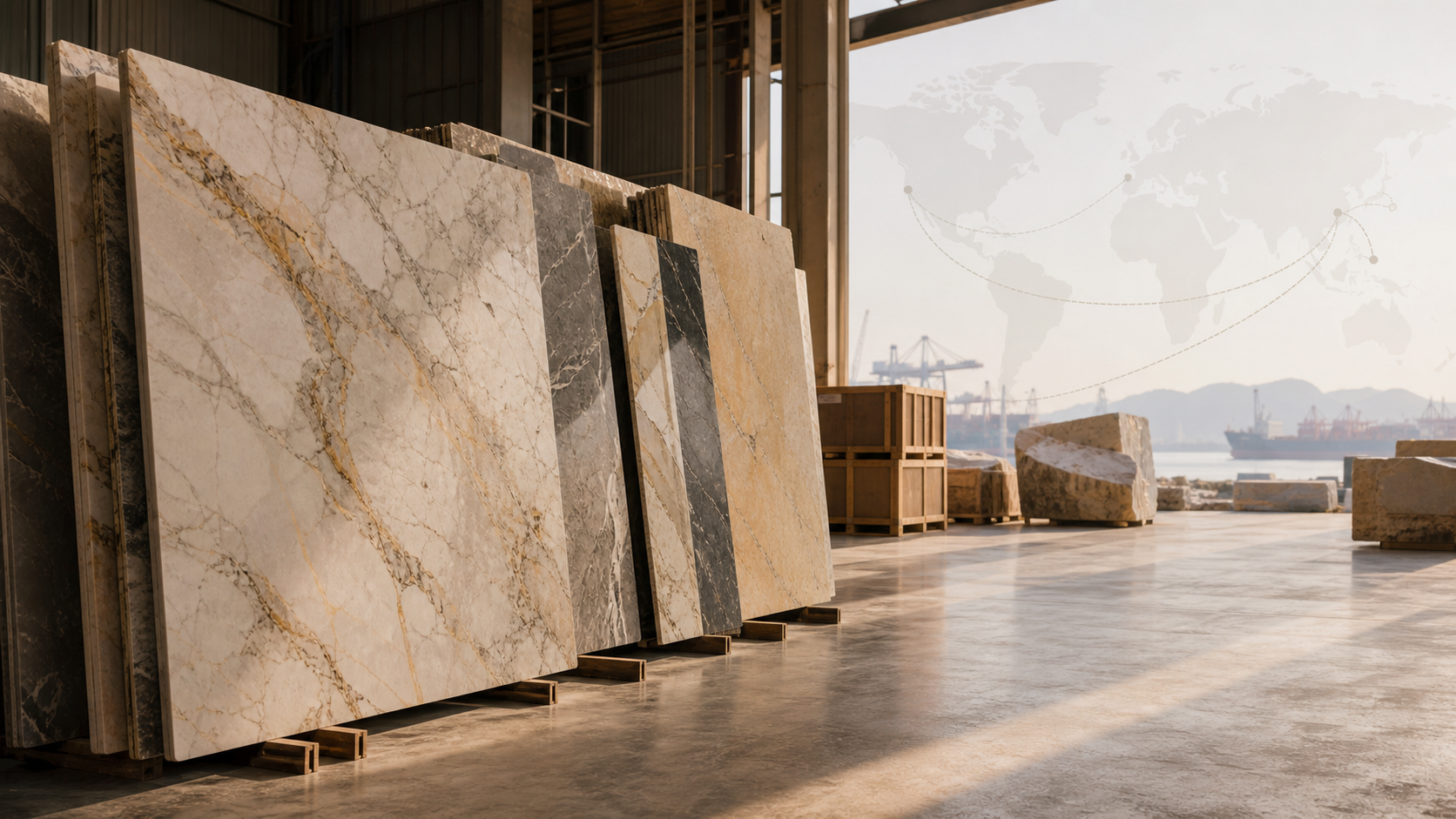
Local stone prices include more than the stone
When you buy stone locally, you are not only paying for the slab. You are also paying for the long path the stone has already taken before it reaches a showroom near you.
A local price often includes the importer, distributor, warehouse, showroom, sales team, local delivery, and the risk each company adds into its margin. None of those costs are wrong. They are part of running a local business. But they do make the final price higher.
That is why two people can look at the same stone and see very different numbers. One person is buying near the source. The other is buying after the stone has passed through several hands.
The chain can have 3 or 4 markups
A normal stone chain can look like this: quarry, block trader, slab factory, exporter, importer, local distributor, retailer, and then the final buyer. Depending on the material and country, some steps may be combined, but the idea is the same. Every step needs to earn money.
If three or four people each add around 10 percent, the difference can quickly become 30 to 40 percent before the stone reaches the final client. This is one of the biggest reasons a direct sourcing model can save money.
With John, the chain is much shorter. It is mostly John and you. That does not remove every cost, because fabrication, packing, inspection, shipping, and documents still matter. But it removes many layers of repeated margin.
Shuitou is closer to where the stone starts
Shuitou is not just one showroom. It is a stone town where blocks, slab yards, cutting factories, polishing teams, packing teams, and exporters sit close to each other.
Many blocks are pulled into Shuitou before they become slabs, countertops, tiles, or stone furniture. Some stones come from China. Many others come from countries such as Italy, Turkey, Brazil, Iran, Greece, Vietnam, and more, then get processed or traded through Shuitou.
Being there matters because decisions happen earlier. John can compare the block, slab, factory, finish, packing method, and price before the stone has moved through a long overseas chain.
The selection is much bigger than a local showroom
Most local suppliers are built for individual buyers. They may show several slabs of a popular marble or quartzite, but they usually do not carry deep stock for every stone. Their job is to sell what is already in their warehouse.
Shuitou works more like a wholesale stone system. There are dozens of large block yards, and each yard can hold hundreds or thousands of blocks. Slab warehouses and factories are nearby, so one search can cover many more options than a normal local visit.
This also changes what you can buy. In a local retail market, buying one bundle can be difficult because suppliers often split material for many small customers. In Shuitou, buying one bundle is normal, because the market is built for larger wholesale movement.
Fabrication in China costs less
China usually has lower labor costs than the United States, Canada, Australia, or many European countries. But price is only one part of the advantage. The other part is experience.
Stone factories in Shuitou cut, polish, edge, reinforce, pack, and export stone every day. The repeated experience matters. A team that handles countertops, vanity tops, tables, stairs, sinks, and slabs every week can often work faster and more efficiently.
Because the factories are close to the slab yards, there is less running around. The stone can be selected, checked, cut, finished, packed, and prepared for export within the same local stone ecosystem.
Shipping costs money, but it does not always erase the saving
International shipping is real. Crates, documents, freight, duties, port fees, and local delivery all need to be counted. For a very small repair job or one tiny piece, buying locally may still make more sense.
But for slabs, countertops, vanity tops, stone furniture, multiple pieces, or one bundle of material, the saving can still be meaningful after shipping. This is where the "at least 30 percent" idea often comes from: fewer markups plus lower fabrication cost can be bigger than the added shipping cost.
The important thing is to calculate the whole project, not just the slab price. A cheap slab with bad packing is not cheap. A beautiful stone that cracks during shipping is not a saving. The goal is a lower total cost with the right material, correct fabrication, and safe packing.
When direct sourcing makes the most sense
Direct sourcing from China makes the most sense when you care about selection, custom work, or buying enough stone for the shipping cost to be reasonable. Examples include a full kitchen, several bathroom vanities, stone tables, wall pieces, stairs, or a bundle of slabs.
It is also useful when your local market cannot find the stone you want. Shuitou gives John a much wider search area, so he can compare similar stones, different grades, different finishes, and different factories before you commit.
The simplest way to start is to send a photo, rough dimensions, where the stone will be used, and your country. Then John can check whether the saving is real for your project, or whether local buying would be simpler.
Questions people usually ask
Can buying stone from China really save 30 percent?
Often, yes, especially when the project is large enough. The saving usually comes from fewer middlemen, lower fabrication cost, and more direct access to Shuitou stone yards and factories. The final number depends on material, quantity, fabrication, packing, shipping, duties, and delivery.
Is buying stone locally always more expensive?
Not always. For a very small piece, urgent repair, or simple local job, local buying can be easier. Direct China sourcing works best when selection, custom fabrication, or project size makes the overseas process worthwhile.
Why does Shuitou have more stone options?
Shuitou is a large stone trading and fabrication center. Many blocks and slabs pass through the area, and dozens of large yards and factories are close to each other. That makes comparison much easier than relying on one local showroom.
What should I send before asking for a quote?
Send a reference photo, rough dimensions, the stone use, quantity, destination country, and any deadline. With that information, John can check material options, fabrication method, packing, shipping, and whether direct sourcing is likely to save money.